
Massive Growth of Online Hate

Did you know that the brutal attack of October 7, 2023 ignited a firestorm of online antisemitism?
And did you know that this online hatred of the Jewish people has not only persisted but is evolving and spreading around the globe.
The Online Hate Prevention Institute (OHPI) has just released a sobering report, Social Media and the Normalisation of Hate: October 7 Two Years On, which lays out the extent of this hatred. Everyone who cares about the safety and security of the Jewish people worldwide, and about the integrity of our own society and civilization should read, and share, this report.
“This isn’t just about more antisemitism,” the report warns. “It’s about more antisemitic content per item. The content is more antisemitic.” In other words, the hatred surfacing online isn’t just more widespread, it’s more intense, more layered, and often more dangerous.
OHPI tracked nearly 11,000 items of antisemitic content across ten major social media platforms, including Facebook, TikTok, Telegram and BitChute. Their analysis, conducted between October 2023 and September 2025, tells a confronting story. The wave of antisemitism that surged after October 7 never returned to pre-crisis levels. In 2025, it is rising again. On several platforms, it is now worse than ever.
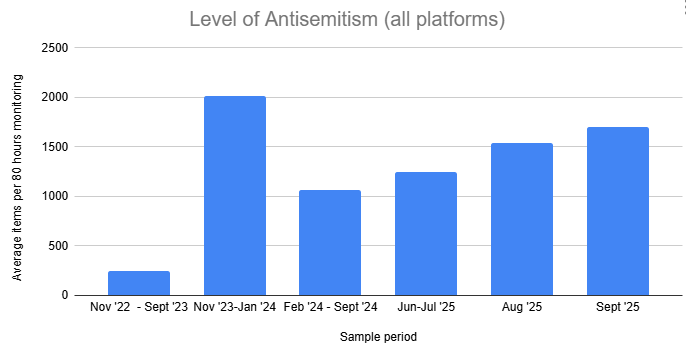
Despite claims that antisemitism is a fringe problem, OHPI’s findings show it is anything but. On three major platforms, antisemitism has reached its highest levels since data collection began. On X (formerly Twitter), the percentage of content promoting traditional antisemitic ideas — including blood libel, global conspiracies, and the age-old charge that Jews killed Jesus — nearly doubled between October 2023 and September 2025. The hateful tropes of the past haven’t disappeared. They’ve been rebranded for modern consumption.
The “Top 10” antisemitic narratives identified in the report paint a grim picture. The most common involved the recycling of traditional antisemitic lies — the kinds of ideas that led to pogroms, expulsions, and genocides throughout Jewish history. Close behind were conspiracy theories about Jewish control of governments and the media. One in four posts analysed used antisemitic imagery to demonise Israel or Zionism. Often, this fuses anti-Israel rhetoric with deeply anti-Jewish language. The result is a toxic blend. It doesn’t just criticise policy. It dehumanises an entire people.
It’s this blurring of lines between politics and prejudice, between criticism and bigotry, that OHPI rightly flags as especially dangerous. The report devotes an entire section to unpacking the difference between legitimate political discourse and antisemitism cloaked in anti-Zionist rhetoric. “Harassing someone after identifying them based on them presenting as Jewish is antisemitic,” it explains. That remains true regardless of whether the attacker invokes Zionism or Israel to justify their abuse.
This is a crucial distinction, particularly in a multicultural democracy like Australia. It reminds us that attacking someone’s Jewish identity — whether through explicit slurs or the appropriation of political language — is still antisemitism. And when that identity is reduced to caricature, stripped of nuance, and made the scapegoat for global conflicts, it becomes something far more corrosive. It becomes a justification for exclusion, for marginalisation, for hate.
In perhaps the most chilling section of the report, OHPI highlights the re-emergence of Holocaust inversion. This includes comparing Israel to Nazis, or equating Jewish suffering with Jewish villainy. This is not just offensive. It is historically perverse. Such comparisons do not educate or illuminate. They desecrate memory and embolden hate.
Dr. André Oboler, CEO of OHPI, puts it plainly: “We are seeing an overt effort to normalise antisemitism in society.” That word — normalise — should stop us in our tracks. The problem is no longer just that hate exists. It is that hate is being treated as ordinary. When antisemitic content is posted, shared, and left unchecked, it sends a clear message. This is acceptable now.
The danger is not confined to the digital world. What happens online spills offline. Ideas matter. Repeated ideas — especially hateful ones — become part of the social landscape. They shape how Jews are treated at universities, on the streets, and in the public square. They influence whether synagogues are safe, whether Jewish schools need extra security, whether Jewish Australians feel like full members of the society they love.
That’s what makes this report so vital. It’s not just a technical analysis of social media metrics. It’s a moral warning. The lines are being redrawn. What we tolerate now sets the tone for what we become.
So where does that leave us? As Australians — people who value fairness, respect, compassion, and truth — we cannot allow antisemitism to become a normal part of our discourse. We must name it, reject it, and act against it. That means calling out hate when we see it. It means standing alongside our Jewish neighbours, not only in moments of crisis, but in the long, quiet work of solidarity. It means pushing platforms and institutions to do better. And it means remembering that the fight against antisemitism is not just a Jewish issue. It is a test of who we are as a people.
Because if hate is allowed to fester, unchallenged, it doesn’t just poison its targets. It poisons us all.
We urge you to read the Social Media and the Normalisation of Hate: October 7 Two Years On report and send it to your elected representatives to raise awareness and prevent the rise of antisemitism in your community.
Latest
The Royal Commission will not solve antisemitism in Australia
Posted by Mark Leach on May 04, 2026
The Royal Commission will not solve antisemitism in Australia!
Why?
The pro-Palestinian movement (the Marxist/Jihadist alliance) has created the permission structure for antisemitism globally.
Islam’s...
Can our national "solidarity" be restored?
Posted by Mark Leach on April 24, 2026
One way to understand WW2 (and much of the 20th and 21st centuries) is an existential conflict between authoritarian regimes and countries and cultures which...
Dear Fellow Australian
Posted by Mark Leach on April 22, 2026
Dear Fellow Australian,
I’m just like you - a regular bloke trying to get on with life. I pay my taxes, watch the footy, worry...
At a Time Such as This, Australian Churches Can Shine Light into the Darkness
Posted by David S on April 20, 2026
Your church is able to help make antisemitism unthinkable in Australia
Mission and calling
As a people of God, we are called “to do justice...